






Ovagen 20mg
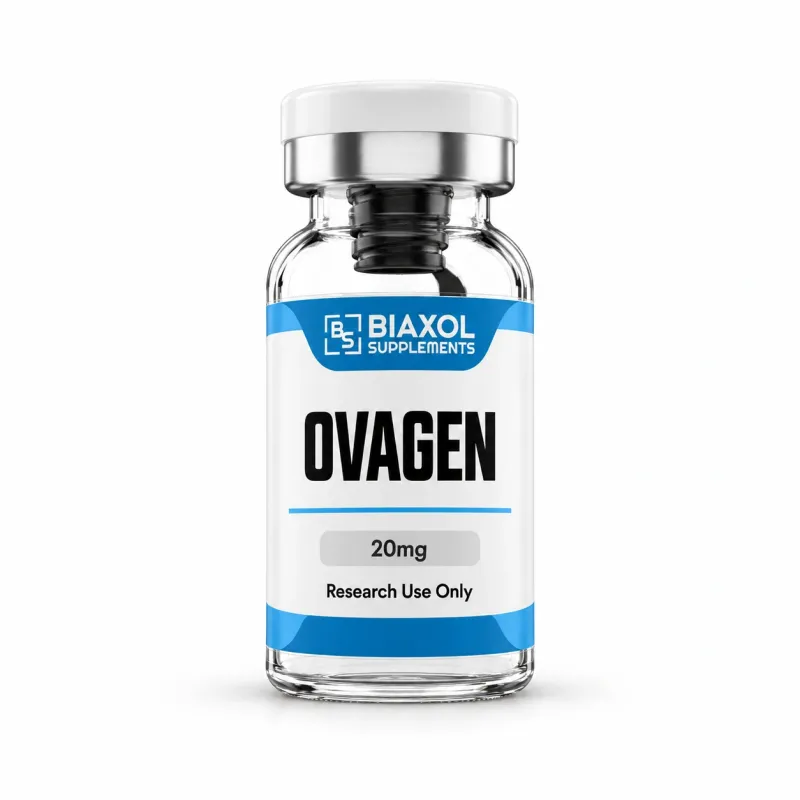
Ovagen 20mg
Ovagen is a synthetic tripeptide bioregulator investigated in hepatic and gastrointestinal tissue models.
-25% on everything – until October 31
25% off regular prices, replacing other product sales. Only the crypto payment discount can be combined.
Overview
Ovagen is a synthetic tripeptide bioregulator investigated in hepatic and gastrointestinal tissue models. Research interest centers on its proposed influence on tissue-specific signalling pathways associated with extracellular matrix regulation, epithelial integrity, and cellular homeostasis.
Experimental studies have examined its activity in liver and gastrointestinal systems, with applications spanning fibrosis-related pathway investigation, epithelial barrier research, and comparative bioregulatory peptide pharmacology.
- High Purity – 99% Purity Guaranteed
- Independently Lab Tested
- Research Grade Quality
- For Laboratory Research Use Only
Properties
| Chemical Formula | C15H25N3O8 |
|---|---|
| Synonyms | EDL, glutamyl-aspartyl-leucine, SCHEMBL5329396, 1a30, CHEBI:137252 |
| Molar Mass | 375.37 g/mol |
| PubChem CID | 444128 |
| Total Compound Content | 20mg per vial |
| Shelf Life | 36 months |
Research
Ovagen is studied as a synthetic tripeptide bioregulator with activity in hepatic and gastrointestinal research models. Experimental investigations have examined its influence on cellular signalling pathways involved in extracellular matrix dynamics, tissue integrity, and stress-response mechanisms. Research applications include hepatic tissue pathway studies, gastrointestinal epithelial biology, cellular homeostasis research, and comparative analysis of tissue-specific bioregulatory peptides. Independently third-party HPLC-tested; COA available per batch.FAQ
What hepatic tissue models are used to study Ovagen's proposed effects on fibrosis-related pathways?
Research commonly utilizes hepatocyte cultures, hepatic stellate cell models, and liver tissue explant systems to investigate fibrosis-associated pathways. Typical endpoints include collagen synthesis, extracellular matrix regulation, stellate cell activation markers, and transcriptional changes associated with tissue remodelling and cellular stress responses.
How is Ovagen's proposed effect on gastrointestinal mucosal integrity investigated?
Experimental studies frequently employ intestinal epithelial cell cultures and barrier-function models to evaluate epithelial integrity and cellular homeostasis. Common measurements include tight-junction protein expression, permeability assays, barrier-function markers, and signalling pathways involved in epithelial maintenance and tissue resilience.
What experimental approaches are used to investigate Ovagen's relevance to viral replication mechanism research?
Cell-based infection models are commonly used to examine interactions between viral replication pathways and host-cell responses. Typical endpoints include viral replication markers, cellular stress responses, inflammatory signalling pathways, and tissue-specific gene-expression changes, allowing researchers to characterize whether observed effects are associated with direct modulation of replication processes or broader cellular regulatory mechanisms.