


Myostatin 1mg
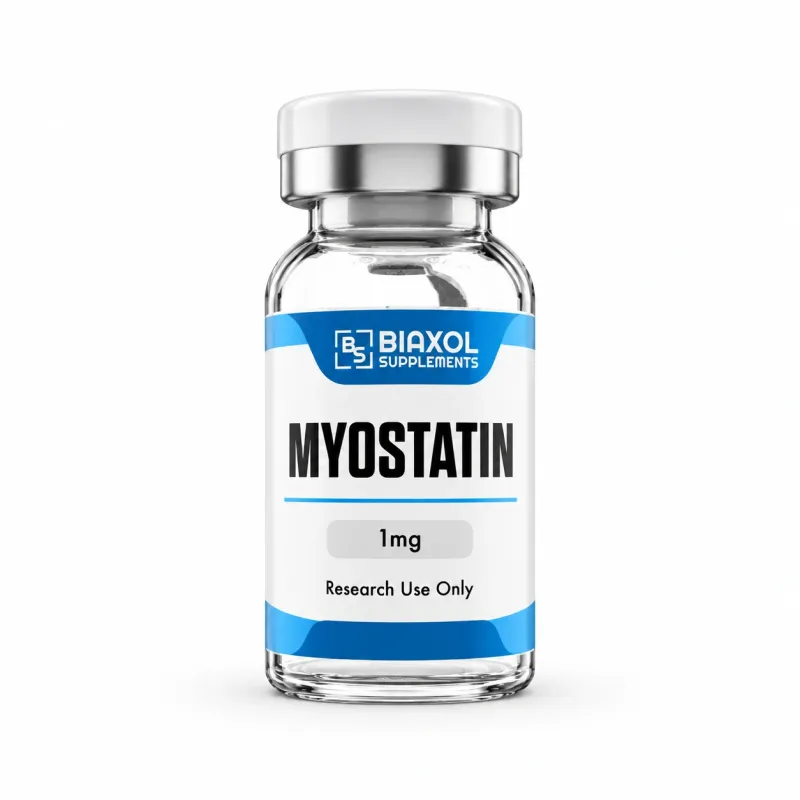
Myostatin 1mg
MIP-7 (Myostatin Inhibitory Peptide 7) is a synthetic 24-amino-acid, C-terminally amidated peptide (AWRQNTRYSRIEAIKIQILSKLRL-NH2) derived from the N-terminal α-helical region of the mouse myostatin prodomain.
The image represents one available format. Strength and pack size are those selected above.
-25% on everything – until October 31
25% off regular prices, replacing other product sales. Only the crypto payment discount can be combined.
Overview
MIP-7 (Myostatin Inhibitory Peptide 7) is a synthetic 24-amino-acid, C-terminally amidated peptide (AWRQNTRYSRIEAIKIQILSKLRL-NH2) derived from the N-terminal α-helical region of the mouse myostatin prodomain. In the native latent complex, this region of the prodomain helps hold mature myostatin (GDF-8) in an inactive state.
MIP-7 was developed to reproduce that inhibitory interaction in a short, synthetically accessible sequence. It is not myostatin itself and does not activate the myostatin pathway. It is studied as a myostatin antagonist, binding the mature growth factor and reducing its ability to signal through activin type II receptors (ACVR2A/ACVR2B) and downstream Smad2/3.
Research applications include myostatin inhibition studies, prodomain–ligand interaction research, structure–activity work on peptide-based TGF-β superfamily antagonists, and muscle biology models where myostatin signalling is suppressed.
- High Purity – 99% Purity Guaranteed
- Independently Lab Tested
- Research Grade Quality
- For Laboratory Research Use Only
Properties
| Chemical Formula | C133H227N43O33 |
|---|---|
| Synonyms | 1621169-52-5, Myostatin inhibitory peptide 7, U8DGS69FVC Ala-Trp-Arg-Gln-Asn-Thr-Arg-Tyr-Ser-Arg-Ile-Glu-Ala-Ile-Lys-Ile-Gln-Ile-Leu-Ser-Lys-Leu-Arg-Leu-NH2, UNII-U8DGS69FVC, CHEMBL3410227, L-Alanyl-L-tryptophyl-L-arginyl-L-glutaminyl-L-asparaginyl-L-threonyl-L-arginyl-L-tyrosyl-L-seryl-L-arginyl-L-isoleucyl-L-alpha-glutamyl-L-alanyl-L-isoleucyl-L-lysyl-L-isoleucyl-L-glutaminyl-L-isoleucyl-L-leucyl-L-seryl-L-lysyl-L-leucyl-L-arginyl-L-leucinamide, orb2563812 |
| Molar Mass | 2956.5 g/mol |
| CAS Number | 1621169-52-5 |
| PubChem CID | 118732224 |
| Available formats | 1 vial · KIT (10 vials) |
| Shelf Life | 24 months |
Research
Myostatin (GDF-8) is a TGF-β superfamily growth factor that negatively regulates skeletal muscle mass. It is synthesised as a precursor and held in a latent state by its own prodomain, which shields the receptor-binding surfaces of the mature dimer. Peptides derived from the prodomain therefore represent a direct route to myostatin inhibition.
MIP-7 comes out of structure–activity work by Takayama and colleagues (J Med Chem, 2015), which narrowed the mouse myostatin prodomain down to a minimum inhibitory sequence and then refined it. Follow-up structural studies indicate the peptide adopts an α-helical conformation and interacts with mature myostatin in a way that interferes with receptor engagement.
MIP-7 is used in vitro to inhibit myostatin-induced Smad2/3 signalling and reporter activity, typically alongside recombinant myostatin as the activating ligand. Additional applications include comparison against other myostatin inhibitors (follistatin, soluble ACVR2B, antibodies), investigation of prodomain-mediated latency, and design of next-generation peptide antagonists.
Independently third-party HPLC-tested; COA available per batch.
FAQ
Is MIP-7 the same as myostatin (GDF-8)?
No. Myostatin (GDF-8) is a ~25 kDa homodimeric growth factor that activates the ACVR2B/Smad2/3 pathway. MIP-7 is a 24-residue synthetic peptide (2956.5 g/mol) derived from the myostatin prodomain, and it is studied as an inhibitor of myostatin rather than an activator.
What is the primary research use of MIP-7?
MIP-7 is used to inhibit myostatin activity in experimental systems. A common design pairs recombinant myostatin (to activate Smad2/3 signalling) with MIP-7 to measure how effectively the peptide suppresses that response, using reporter assays, Smad2/3 phosphorylation or downstream transcriptional readouts.
What controls are important in MIP-7 experiments?
Common controls include vehicle-only samples for baseline, myostatin-only samples to confirm pathway activation, a scrambled or inactive peptide to rule out non-specific effects, and an established myostatin inhibitor (such as follistatin or a neutralising antibody) as a benchmark for inhibition.