





Thymosin Alpha 1
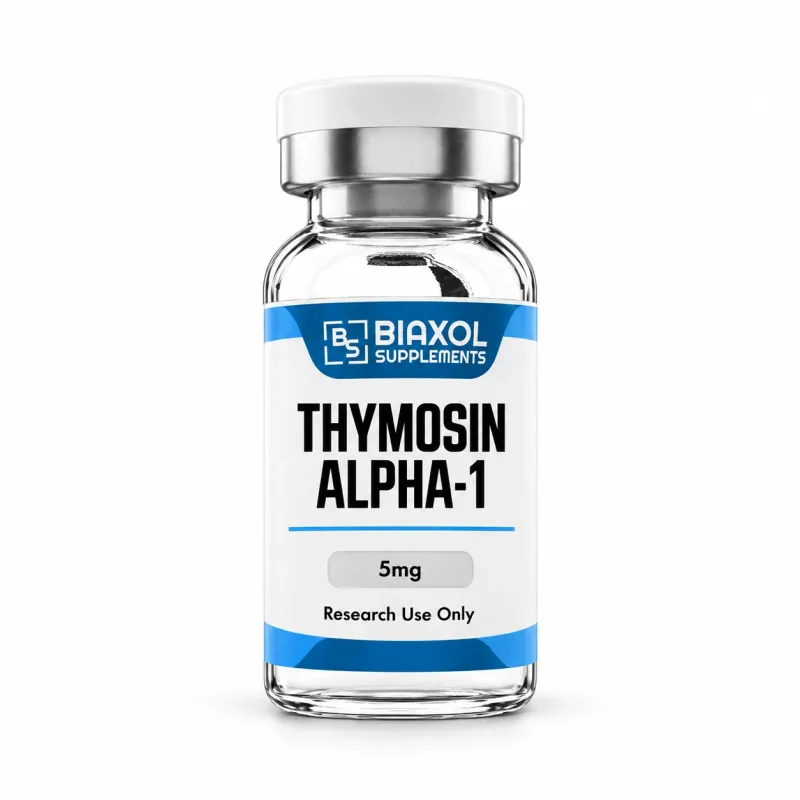
Thymosin Alpha 1
Thymosin Alpha 1 (Tα1) is a synthetic peptide fragment derived from prothymosin alpha, known for its role in intracellular signaling and peptide-mediated regulatory pathways.
L’image présente un des formats disponibles. Le dosage et le conditionnement correspondent à la sélection ci-dessus.
-25% sur tout – jusqu’au 31 octobre
25% sur les prix habituels, en remplacement des autres soldes. Cumulable uniquement avec la remise crypto.
Présentation
Thymosin Alpha 1 (Tα1) is a synthetic peptide fragment derived from prothymosin alpha, known for its role in intracellular signaling and peptide-mediated regulatory pathways. It interacts with toll-like receptors (TLRs) and major histocompatibility complex (MHC) molecules, modulating molecular signaling cascades.
This peptide undergoes proteolytic degradation, with primary metabolism occurring via enzymatic hydrolysis and renal clearance.
- High Purity – 99% Purity Guaranteed
- Independently Lab Tested
- Research Grade Quality
- For Laboratory Research Use Only
Données moléculaires sur PubChem
Propriétés
| Chemical Formula | C129H215N33O55 |
|---|---|
| Synonyms | Thymalfasin, Tα1 |
| Molar Mass | 3,108.26 g/mol |
| CAS Number | 62304-98-7 |
| PubChem CID | 16130571 |
| Formats disponibles | 1vial 5mg · KIT (10 vials) 50mg |
| Shelf Life | 36 months |
Recherche
Thymosin Alpha-1 (Ac-Ser-Asp-Ala-Ala-Val-Asp-Thr-Ser-Ser-Glu-Ile-Thr-Thr-Lys-Asp-Leu-Lys-Glu-Lys-Lys-Glu-Val-Val-Glu-Glu-Ala-Glu-Asn) is a synthetic 28-amino-acid N-terminally acetylated peptide that interacts with multiple innate immune signaling pathways, including Toll-like receptor-associated regulatory networks. Experimental investigations have examined its interactions with TLR9-, TLR2-, and MyD88-dependent signaling mechanisms, resulting in modulation of downstream transcriptional pathways including NF-κB-associated gene regulation. Research has also explored its effects on dendritic cell signaling processes, antigen-presentation pathways, cytokine-associated regulatory networks, and peptide-mediated immune communication systems. These characteristics make Thymosin Alpha-1 a valuable research tool for studies of innate immune pathway pharmacology, Toll-like receptor signaling, immunomodulatory peptide mechanisms, and coordinated immune regulatory networks. Supplied as a lyophilized preparation (5 mg/vial). Independently third-party HPLC-tested; COA available per batch.Résultats de laboratoire
Results refer to the tested sample. Check the batch and date in the report.

FAQ
What is the mechanism by which Thymosin Alpha-1 interacts with innate immune signaling pathways?
Thymosin Alpha-1 has been extensively investigated for its interactions with Toll-like receptor-associated signaling networks, particularly TLR9- and TLR2-dependent pathways. Experimental studies have demonstrated activation of MyD88-dependent signaling cascades, resulting in modulation of downstream transcriptional regulators including NF-κB.
These signaling interactions make Tα1 a valuable research tool for investigating pattern-recognition receptor pharmacology, innate immune signaling mechanisms, and coordinated immune regulatory networks.
How does Thymosin Alpha-1 differ from Thymosin Beta-4 (TB-500) in research applications?
Thymosin Alpha-1 and Thymosin Beta-4 are structurally distinct thymic-derived peptides with different molecular targets and signaling pathways. Thymosin Alpha-1 is primarily investigated for its interactions with innate immune signaling networks, Toll-like receptor pathways, and immunomodulatory mechanisms.
Thymosin Beta-4 is characterized by its interaction with actin-associated regulatory systems and cytoskeletal signaling pathways. As a result, the two peptides are utilized in distinct areas of peptide pharmacology and mechanistic research.
What are the primary research applications of Thymosin Alpha-1?
Thymosin Alpha-1 is widely used in studies of Toll-like receptor signaling, innate immune pathway regulation, dendritic cell-associated signaling mechanisms, cytokine regulatory networks, and peptide-mediated immune communication systems.
Experimental investigations have examined its role in pattern-recognition receptor pharmacology, immune signaling pathway modulation, and coordinated interactions between innate and adaptive immune regulatory processes. These characteristics make Tα1 a valuable tool for mechanistic studies of immunomodulatory peptide pharmacology.
Produits similaires
-
 OS-01 100mg/30capsAjouter au panierLe prix initial était : €220,00.€165,00Le prix actuel est : €165,00.
-
 SLU-PP-332 PeptideAjouter au panierLe prix initial était : €100,00.€75,00Le prix actuel est : €75,00.