












Phenibut HCL – Powder, 50 grams
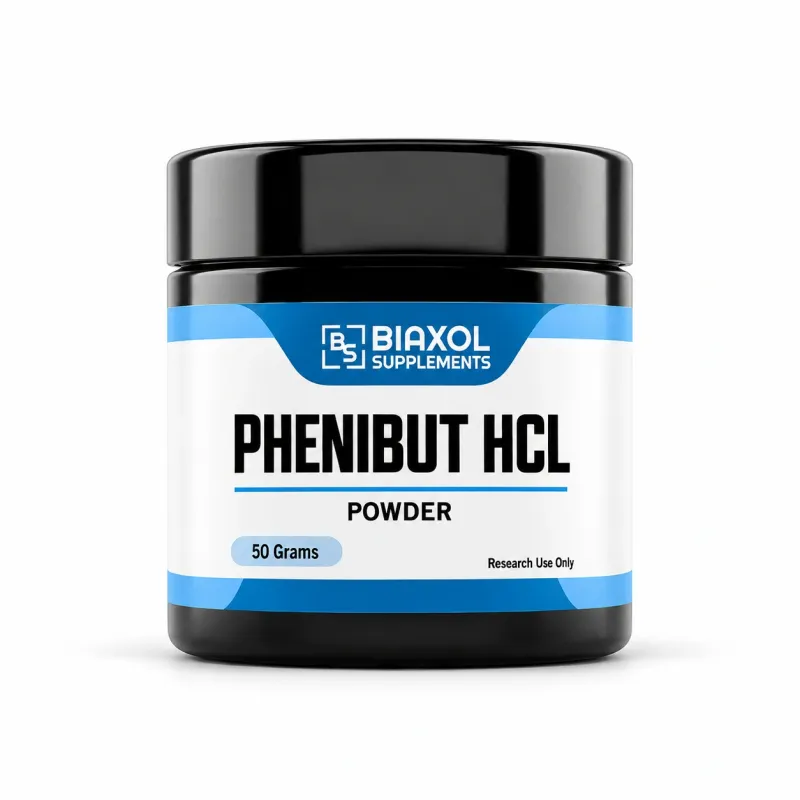
Phenibut HCL – Powder, 50 grams
Phenibut HCL powder (50 g) provides a bulk format of β-phenyl-γ-aminobutyric acid hydrochloride for research applications requiring solution preparation, dose titration, or formulation studies.
-25% sur tout – jusqu’au 31 octobre
25% sur les prix habituels, en remplacement des autres soldes. Cumulable uniquement avec la remise crypto.
Présentation
Phenibut HCL powder (50 g) provides a bulk format of β-phenyl-γ-aminobutyric acid hydrochloride for research applications requiring solution preparation, dose titration, or formulation studies. The compound acts as a GABA-B agonist and GABA-A ρ receptor modulator. The powder format enables flexible concentration preparation and is suited to pharmacokinetic studies, in vitro assays, and custom formulation research protocols.
- High Purity – 99% Purity Guaranteed
- Independently Lab Tested
- Research Grade Quality
- For Laboratory Research Use Only
Propriétés
| Chemical Formula | C10H14ClNO2 |
|---|---|
| Synonyms | 4-Amino-3-phenylbutanoic acid Phenibut 1078-21-3 Fenibut 4-Amino-3-phenylbutyric acid |
| Molar Mass | 215.67 g/mol |
| CAS Number | 3060-41-1 |
| PubChem CID | 11499499 |
| Total Compound Content | 50 g powder |
| Shelf Life | 36 months |
Recherche
Phenibut HCL powder provides the same compound as the capsule format in a bulk, unencapsulated form, enabling researchers to prepare solutions of defined concentration, perform weight-based dose titrations, or develop custom formulations. As a β-phenyl derivative of GABA, phenibut crosses the blood-brain barrier via passive diffusion (unlike GABA itself), acts as a GABA-B receptor agonist (lower potency than baclofen), and modulates GABA-A ρ subunit-containing receptors. Plasma half-life is approximately 5 hours; minimal hepatic metabolism with ~90% urinary excretion unchanged. The 50 g format supports extended-duration studies, cohort-scale dosing, or in vitro concentration-response experiments requiring larger quantities than capsule-based formats allow. Independently third-party HPLC-tested; COA available per batch.Résultats de laboratoire
Results refer to the tested sample. Check the batch and date in the report.

FAQ
What distinguishes the powder format from capsule formulations in research applications?
The powder format provides greater flexibility for analytical investigations, solution preparation, concentration standardization, and formulation development. Researchers can prepare solutions at precisely defined concentrations for biochemical assays, receptor-binding studies, and other laboratory applications.
This versatility makes the powder format particularly useful for experimental designs requiring custom concentrations or multiple formulation conditions.
What are the solubility characteristics of Phenibut HCL powder?
Phenibut HCL is highly water-soluble due to its hydrochloride salt form and is also compatible with a variety of commonly utilized laboratory solvent systems. Its favorable solubility profile supports solution preparation, analytical characterization, formulation studies, and investigations of physicochemical properties.
These characteristics make Phenibut HCL a convenient compound for research involving dissolved preparations and solution-based experimental systems.
How does Phenibut differ from baclofen in receptor pharmacology research?
Both Phenibut and baclofen are investigated for interactions with GABA-B receptors, but they exhibit distinct pharmacological and structural characteristics. Phenibut has also been reported to interact with GABA-A ρ (rho) receptor systems, providing a broader receptor interaction profile than baclofen.
These differences make Phenibut a useful research tool for comparative investigations of receptor selectivity, ligand-receptor interactions, GABAergic signaling mechanisms, and structure-activity relationships within GABA-related compounds.
Produits similaires
-
 NSI-189 Free Base – Powder, 1 gramAjouter au panierLe prix initial était : €22,99.€17,24Le prix actuel est : €17,24.
-
 RU58841 – Powder, 5 gramsAjouter au panierLe prix initial était : €63,99.€47,99Le prix actuel est : €47,99.
-
 Dihexa – Powder, 500mgLire la suiteLe prix initial était : €97,99.€73,49Le prix actuel est : €73,49.
-
 NSI-189 Phosphate – Powder, 1 gramAjouter au panierLe prix initial était : €24,99.€18,74Le prix actuel est : €18,74.