IGF-1 DES 1 mg
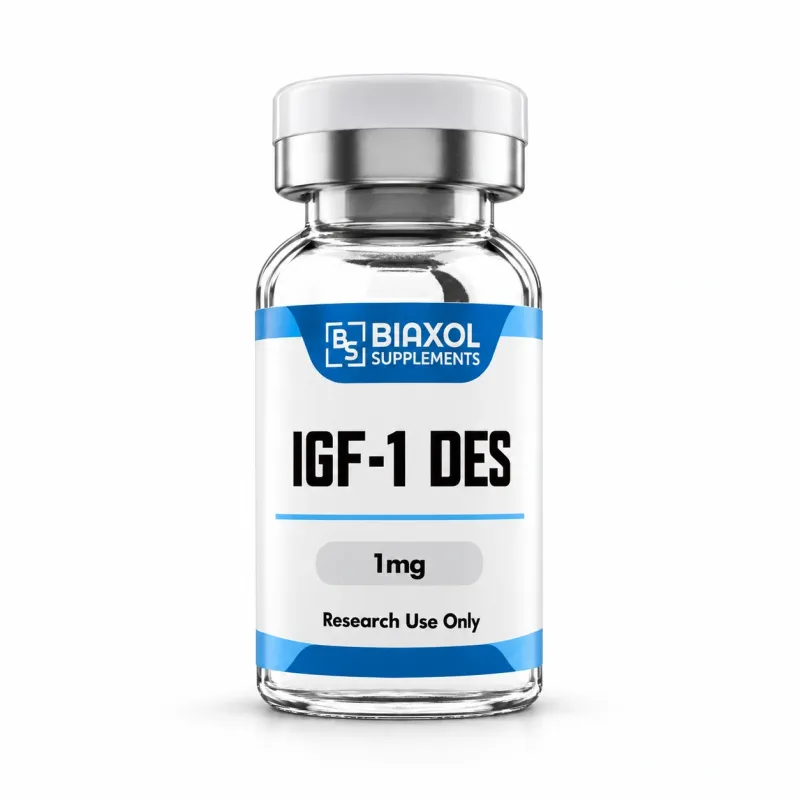
IGF-1 DES 1 mg
IGF-1 DES (Des(1-3)IGF-1) is a naturally occurring, endogenous truncated form of IGF-1 lacking the first three N-terminal amino acids.
L’image présente un des formats disponibles. Le dosage et le conditionnement correspondent à la sélection ci-dessus.
-25% sur tout – jusqu’au 31 octobre
25% sur les prix habituels, en remplacement des autres soldes. Cumulable uniquement avec la remise crypto.
Présentation
IGF-1 DES (Des(1-3)IGF-1) is a naturally occurring, endogenous truncated form of IGF-1 lacking the first three N-terminal amino acids. This truncation reduces IGFBP affinity by approximately 10-fold relative to native IGF-1 while modestly increasing IGF-1 receptor binding potency.
The shorter half-life and higher local potency of IGF-1 DES make it a useful research tool for studying IGF-1R activation dynamics distinct from the longer-acting IGF-1 LR3 analogue.
- High Purity – 99% Purity Guaranteed
- Independently Lab Tested
- Research Grade Quality
- For Laboratory Research Use Only
Propriétés
| Chemical Formula | C319H501N91O96S7 |
|---|---|
| Synonyms | IGF1 Human Des1-3; Insulin-Like Growth Factor 1 Des (1-3) Human Recombinant; Somatomedin C; IGF-I; IGFI; IGF1; IGF-IA; Des(1-3); Des1-3; Des 1-3; Des (1-3); IGF-1 (4-70); IGF1 Des1-3 |
| Molar Mass | 7,649 g/mol |
| CAS Number | 112603-35-7 |
| Total Compound Content | 1 mg per vial |
| Shelf Life | 36 months |
Recherche
IGF-1 DES is a truncated analogue of insulin-like growth factor 1 (IGF-1) in which the three N-terminal amino acids are absent relative to the full-length peptide. This structural modification alters its interaction profile with insulin-like growth factor binding proteins (IGFBPs), resulting in a greater proportion of unbound peptide available for receptor interaction. IGF-1 DES retains high-affinity binding to the insulin-like growth factor 1 receptor (IGF-1R) and preserves activation of downstream receptor-mediated signaling pathways, including PI3K/Akt/mTOR and MAPK/ERK cascades. The modified structure and distinct receptor-accessibility profile make IGF-1 DES a valuable research tool for investigating IGF-1R pharmacology, ligand-receptor interactions, growth factor signaling mechanisms, and comparative studies of IGF-1 analogues. Supplied as a lyophilized preparation (1 mg/vial). Independently third-party HPLC-tested; COA available per batch.FAQ
How does IGF-1 DES differ from IGF-1 LR3 in terms of receptor interaction characteristics?
IGF-1 DES and IGF-1 LR3 are structurally modified forms of IGF-1 that differ in their interactions with insulin-like growth factor binding proteins (IGFBPs) and their resulting receptor-accessibility profiles. IGF-1 DES utilizes N-terminal truncation, whereas IGF-1 LR3 incorporates amino acid substitution and sequence extension.
These structural differences make both compounds useful research tools for investigating IGFBP interactions, ligand-receptor dynamics, and comparative IGF-1 receptor pharmacology.
What distinguishes IGF-1 DES from full-length IGF-1?
IGF-1 DES is a truncated analogue of IGF-1 in which the N-terminal region has been modified relative to the full-length peptide. This structural change alters its interaction characteristics while preserving high-affinity binding to the insulin-like growth factor 1 receptor (IGF-1R).
As a result, IGF-1 DES is frequently used in studies examining structure-function relationships, receptor activation mechanisms, and the influence of peptide architecture on growth factor signaling pathways.
Why is IGF-1 DES useful for growth factor signaling research?
IGF-1 DES retains activation of key IGF-1R-mediated signaling pathways, including PI3K/Akt/mTOR and MAPK/ERK regulatory cascades. Its modified structure and distinct interaction profile make it a valuable research tool for investigating ligand-receptor interactions, growth factor signaling mechanisms, receptor pharmacology, and comparative studies of IGF-1 analogues and related signaling systems.
Produits similaires
-
 SLU-PP-332 PeptideAjouter au panierLe prix initial était : €100,00.€75,00Le prix actuel est : €75,00.
-
 OS-01 100mg/30capsAjouter au panierLe prix initial était : €220,00.€165,00Le prix actuel est : €165,00.