











FTPP (Adipotide) 5mg
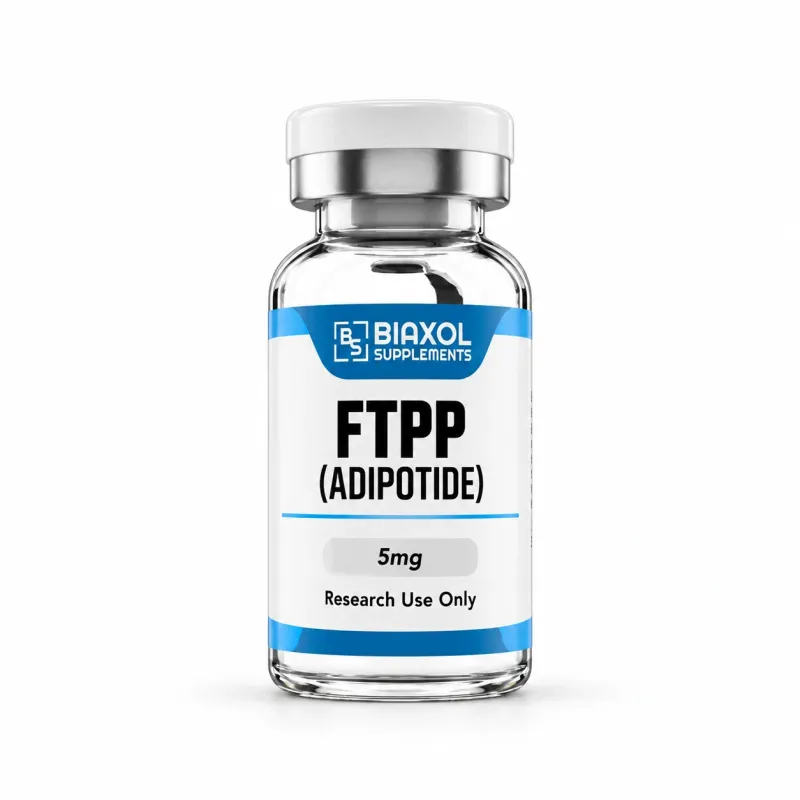
FTPP (Adipotide) 5mg
FTPP (Adipotide) is a synthetic peptide conjugate combining a prohibitin-targeting homing sequence with a proapoptotic domain, designed to selectively engage prohibitin proteins expressed on the surface of vascular endothelial cells supplying specific tissue beds.
La imagen representa uno de los formatos disponibles. La concentración y el envase corresponden a la selección anterior.
-25% en todo – hasta el 31 de octubre
25% sobre los precios habituales, en sustitución de otras ofertas. Acumulable solo con el descuento crypto.
Descripción
FTPP (Adipotide) is a synthetic peptide conjugate combining a prohibitin-targeting homing sequence with a proapoptotic domain, designed to selectively engage prohibitin proteins expressed on the surface of vascular endothelial cells supplying specific tissue beds.
Research interest centers on its targeted proapoptotic mechanism, distinguishing it from systemically acting apoptosis-inducing compounds. Research applications include prohibitin receptor-targeting research, vascular-targeted peptide delivery studies, and adipose tissue vasculature pathway investigation.
- High Purity – 99% Purity Guaranteed
- Independently Lab Tested
- Research Grade Quality
- For Laboratory Research Use Only
Propiedades
| Chemical Formula | C111H206N36O28S2 |
|---|---|
| Synonyms | EX-A6186, proapototic peptide |
| Molar Mass | 2557.2 g/mol |
| CAS Number | 859216-15-2 |
| PubChem CID | 163360068 |
| Formatos disponibles | 1 vial · KIT (10 vials) |
| Shelf Life | 36 months |
Investigación
FTPP (Adipotide) is engineered as a bifunctional peptide combining a CKGGRAKDC homing motif that binds prohibitin proteins on the surface of white adipose tissue vasculature with a proapoptotic peptide domain (KLAKLAK)2 that, once internalised via prohibitin engagement, disrupts mitochondrial membrane integrity to trigger localised apoptosis. This vascular-targeting strategy is studied as a model for tissue-selective peptide delivery, in which the homing domain confers spatial specificity while the proapoptotic payload provides the functional effect, independent of systemic apoptotic signalling. Research applications include characterising prohibitin expression patterns across vascular beds, validating the homing-domain specificity using competitive binding and biodistribution studies, and using FTPP as a tool compound for studying adipose tissue vasculature remodelling following targeted endothelial apoptosis induction. Independently third-party HPLC-tested; COA available per batch.FAQ
Q: What is the mechanistic basis of FTPP's prohibitin-targeted homing strategy?
FTPP incorporates a CKGGRAKDC peptide sequence that binds selectively to prohibitin, a protein expressed on the luminal surface of vascular endothelial cells supplying white adipose tissue at higher density than in many other vascular beds. This homing domain directs the conjugated proapoptotic payload specifically to prohibitin-expressing endothelium, providing a model system for studying tissue-selective vascular targeting strategies based on differential surface receptor expression rather than systemic drug distribution.
How does the proapoptotic (KLAKLAK)2 domain in FTPP induce localized cell death once internalized?
The (KLAKLAK)2 domain is a synthetic cationic amphipathic peptide that, upon cellular internalisation following prohibitin-mediated binding, disrupts mitochondrial membrane integrity, triggering the intrinsic apoptotic pathway in the targeted endothelial cell. Because this proapoptotic domain only reaches functionally relevant intracellular concentrations following prohibitin-dependent uptake, the overall mechanism is studied as a model for spatially restricted apoptosis induction, with cell death confined largely to cells expressing the target receptor at sufficient density.
What experimental approaches validate prohibitin-targeting specificity in FTPP research?
Competitive binding assays using free prohibitin-binding peptide (without the proapoptotic payload) to block FTPP uptake, alongside biodistribution studies tracking labeled FTPP localisation across different vascular beds, are standard methods for confirming the homing domain's binding specificity. Comparative studies using a scrambled or non-binding control peptide sequence conjugated to the same proapoptotic domain are also used to confirm that observed effects depend on the specific prohibitin-targeting sequence rather than nonspecific peptide uptake or toxicity.
Productos relacionados
-
 OS-01 100mg/30capsAñadir al carritoEl precio original era: €220,00.€165,00El precio actual es: €165,00.
-
 SLU-PP-332 PeptideAñadir al carritoEl precio original era: €100,00.€75,00El precio actual es: €75,00.