
Follistatin-344 1mg
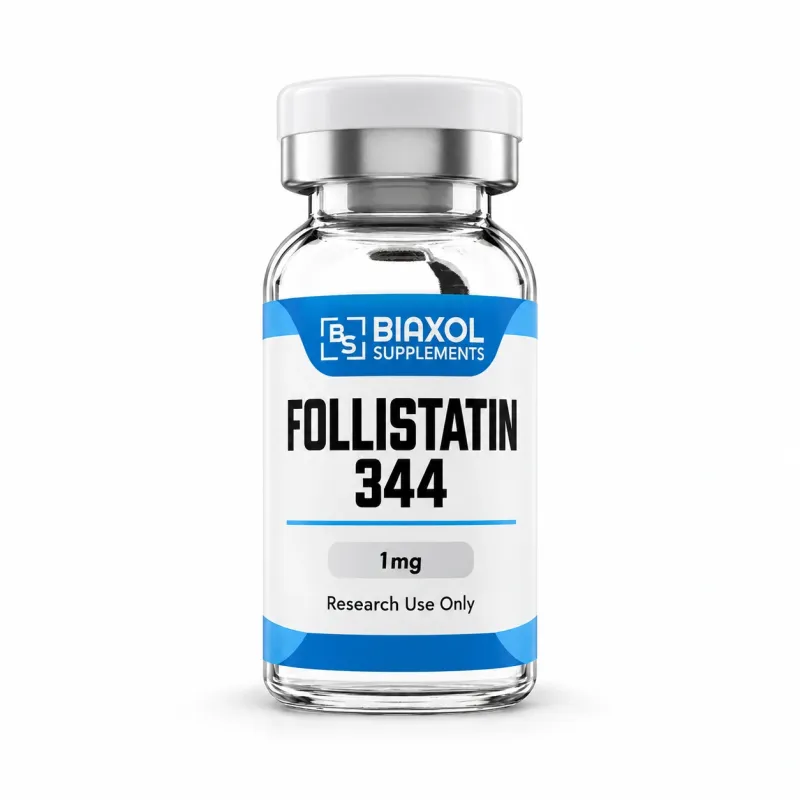
Follistatin-344 1mg
<p><strong>NOTE:</strong> In some cases wherein the assigned top colors are out of stock, a different top color will be used to ensure that your order will not be delayed.</p>
<div></div>
<p><strong>Minimum Order:</strong> 1 Vial</p>
<div></div>
<p><strong>Peptides</strong> are stable at room temperature and can be stored in their original packaging for several days to weeks. For longer storage, keep them at 4 °C or colder, away from intense light. Do not shake peptides before or after reconstitution, refrigerate them, and handle with care.</p>
<p><span style="color: #ff6600"><strong>You can purchase BAC water here:</strong></span><br>
<a href="https://swisschems.org/product/bacteriostatic-water-10ml-bac/">BAC 10ml </a><br>
<a href="https://swisschems.org/product/bacteriostatic-water-bac/">BAC 20ml </a></p>
La imagen representa uno de los formatos disponibles. La concentración y el envase corresponden a la selección anterior.
-25% en todo – hasta el 31 de octubre
25% sobre los precios habituales, en sustitución de otras ofertas. Acumulable solo con el descuento crypto.
Descripción
Follistatin-344 (FS-344) is the predominant isoform of follistatin, an endogenous glycoprotein that functions as a high-affinity binding protein for multiple members of the TGF-β superfamily. By sequestering ligands including activins, myostatin (GDF-8), and selected bone morphogenetic proteins (BMPs), Follistatin-344 prevents receptor engagement and downstream Smad-dependent signal transduction.
Experimental studies have utilized FS-344 to investigate activin receptor signaling, myostatin-associated regulatory pathways, TGF-β superfamily biology, ligand-receptor interaction dynamics, and Smad2/3- and Smad1/5/8-mediated transcriptional regulation.
Its broad ligand-binding profile and well-characterized mechanism make Follistatin-344 a valuable research tool for studies of growth factor signaling networks, extracellular ligand sequestration, pathway cross-talk within the TGF-β superfamily, and comparative investigations of myostatin and activin antagonism.
- High Purity – 99% Purity Guaranteed
- Independently Lab Tested
- Research Grade Quality
- For Laboratory Research Use Only
Propiedades
| Chemical Formula | C203H317N55O64S1 |
|---|---|
| Synonyms | Follistatin FST-344, FS-344, Activin-binding protein |
| Molar Mass | ~35,000 g/mol |
| CAS Number | 100043-71-8 |
| PubChem CID | N/A |
| Formatos disponibles | 1 vial · KIT (10 vials) |
| Shelf Life | 36 months |
Investigación
Follistatin-344 (FS-344) is a 344-amino-acid heparin-binding glycoprotein isoform produced through alternative splicing of the FST gene. It functions as a high-affinity extracellular binding protein for multiple TGF-β superfamily ligands, including activins, myostatin (GDF-8), and selected bone morphogenetic proteins (BMPs). By sequestering these ligands prior to receptor engagement, FS-344 inhibits downstream Smad2/3- and Smad1/5/8-dependent signaling pathways and modulates TGF-β superfamily signal transduction. Experimental investigations have utilized Follistatin-344 to study activin receptor signaling, myostatin-associated regulatory pathways, ligand-receptor interaction dynamics, extracellular growth factor sequestration, and Smad-mediated transcriptional regulation. The FS-344 isoform contains a C-terminal extension that contributes to interactions with heparan sulfate-containing structures, influencing its distribution and localization characteristics relative to other follistatin isoforms. Supplied as lyophilized preparation (1 mg/vial). Independently third-party HPLC-tested; COA available per batch.FAQ
What is the difference between Follistatin-344 and Follistatin-315, and why does isoform matter for research?
Follistatin-344 (FS-344) and Follistatin-315 (FS-315) are alternative splice variants of the FST gene that differ in their C-terminal sequence composition. FS-344 contains an additional peptide region associated with interactions involving heparan sulfate-containing structures, influencing its localization and distribution characteristics.
FS-315 lacks this extension and displays different extracellular distribution properties. These structural differences make isoform selection an important consideration in studies investigating ligand sequestration dynamics, TGF-β superfamily signaling, extracellular protein interactions, and growth factor distribution mechanisms.
Which TGF-β superfamily members does follistatin antagonize, and how selective is this interaction?
Follistatin functions as a broad-spectrum extracellular binding protein for multiple TGF-β superfamily ligands. Its highest-affinity interactions occur with activin family members, while additional binding activity has been documented for myostatin (GDF-8) and selected bone morphogenetic proteins (BMPs).
Because follistatin interacts with several ligand families rather than a single target, it is widely used in studies examining activin signaling, myostatin biology, BMP-associated pathways, receptor-ligand competition, and cross-talk within TGF-β superfamily signaling networks.
What experimental evidence supports follistatin's role in TGF-β superfamily signaling regulation?
Extensive experimental research has demonstrated that follistatin modulates TGF-β superfamily signaling through direct ligand sequestration, preventing receptor engagement and downstream Smad-dependent signal transduction.
Studies utilizing recombinant protein administration, transgenic expression systems, gene-transfer approaches, and in vitro signaling models have consistently shown suppression of activin-, myostatin-, and BMP-associated signaling pathways.
These findings have established follistatin as a widely used research tool for investigating extracellular growth factor regulation, ligand-neutralization mechanisms, Smad signaling networks, and TGF-β superfamily pathway biology.
Productos relacionados
-
 SLU-PP-332 PeptideAñadir al carritoEl precio original era: €100,00.€75,00El precio actual es: €75,00.
-
 OS-01 100mg/30capsAñadir al carritoEl precio original era: €220,00.€165,00El precio actual es: €165,00.