TB-500 Fragment (17-23)
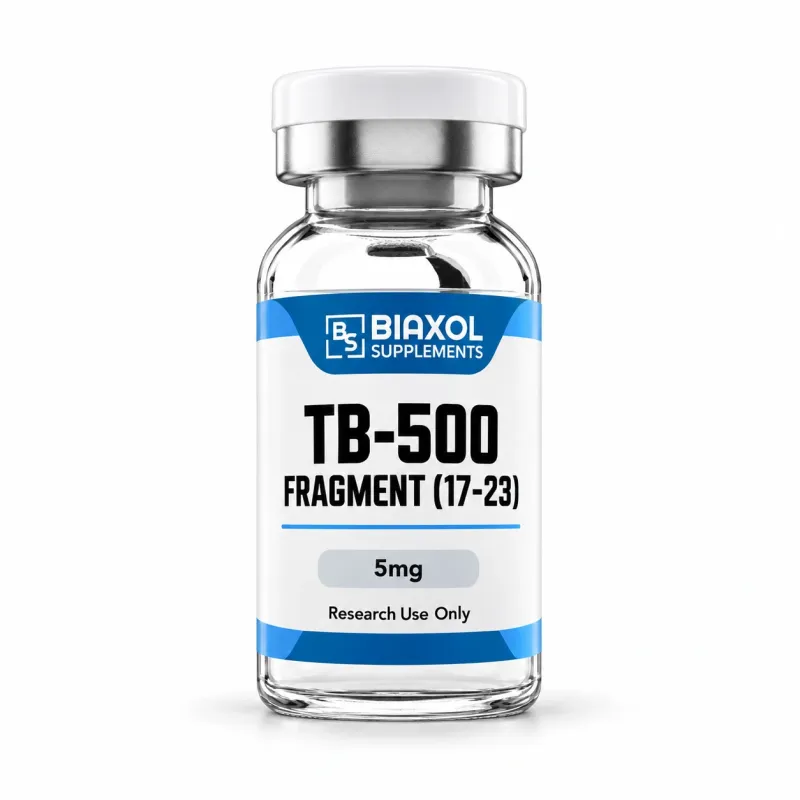
TB-500 Fragment (17-23)
TB-500 Fragment (17-23) is a synthetic research peptide consisting of the key active amino acid sequence from the actin-binding region of thymosin beta-4.
The image represents one available format. Strength and pack size are those selected above.
-25% on everything – until October 31
25% off regular prices, replacing other product sales. Only the crypto payment discount can be combined.
Overview
TB-500 Fragment (17-23) is a synthetic research peptide consisting of the key active amino acid sequence from the actin-binding region of thymosin beta-4. Supplied as a high-purity lyophilized powder, it’s used in laboratory research to study cellular migration, actin dynamics, angiogenic signaling, and tissue remodeling processes.
- High Purity – 99% Purity Guaranteed
- Independently Lab Tested
- Research Grade Quality
- For Laboratory Research Use Only
Properties
| Chemical Formula | C38H68N10O14 |
|---|---|
| Synonyms | TB-500 Fragment (17-23), Thymosin Beta-4 Fragment 17-23, LKKTETQ |
| Molar Mass | 889.02 g/mol |
| CAS Number | 885340-08-9 |
| PubChem CID | 62707662 |
| Available formats | 5mg 1vial · 10mg 1vial |
| Shelf Life | 36 months |
Research
TB-500 Fragment (17-23) is the N-acetylated seven-residue sequence (Ac-Leu-Lys-Lys-Thr-Glu-Thr-Gln) corresponding to the LKKTET actin-binding motif found at position 17–23 of Thymosin Beta-4. Because this short sequence contains the core determinant of Tβ4's interaction with G-actin, it is frequently used in comparative studies examining whether a given cytoskeletal or signaling effect requires the full 43-residue protein or can be reproduced by the isolated binding motif alone.
Experimental work involving this fragment has focused on actin monomer sequestration assays, structure-activity mapping of the Tβ4 actin-binding domain, and mechanistic comparisons between the minimal fragment and full-length Tβ4 in cytoskeletal reorganization models. Because of its small size relative to full-length Tβ4, the fragment is also used in analytical chemistry and mass-spectrometry method development, including doping-control and peptide-identification research.
FAQ
How does TB-500 Fragment (17-23) differ from full-length TB-500/Thymosin Beta-4?
The Fragment (17-23) contains only the seven-residue LKKTET actin-binding motif that sits within the larger 43-residue Tβ4 sequence, rather than the full protein. It is typically used to test whether an observed effect of full-length Tβ4 depends on the whole protein or can be attributed to this minimal actin-binding region alone.
What is the primary research application of this fragment?
It's used mainly in comparative actin-binding and structure-function studies, where researchers assess G-actin interaction and cytoskeletal effects of the isolated motif relative to full-length Thymosin Beta-4. It also sees use in analytical/mass-spectrometry method development for peptide identification.
Is this compound identical to commercial "TB-500"?
The name "TB-500" has been used inconsistently across the peptide supply industry — some vendors apply it to the full 43-residue Tβ4 analogue, while analytical and anti-doping literature identifies "TB-500" specifically as this Ac-LKKTETQ fragment. This listing is the isolated 7-residue fragment (CAS 885340-08-9); check formula and CAS number against any other "TB-500" product before comparing them directly.