
NAD+ (Nicotinamide Adenine Dinucleotide) – Powder, 10 grams
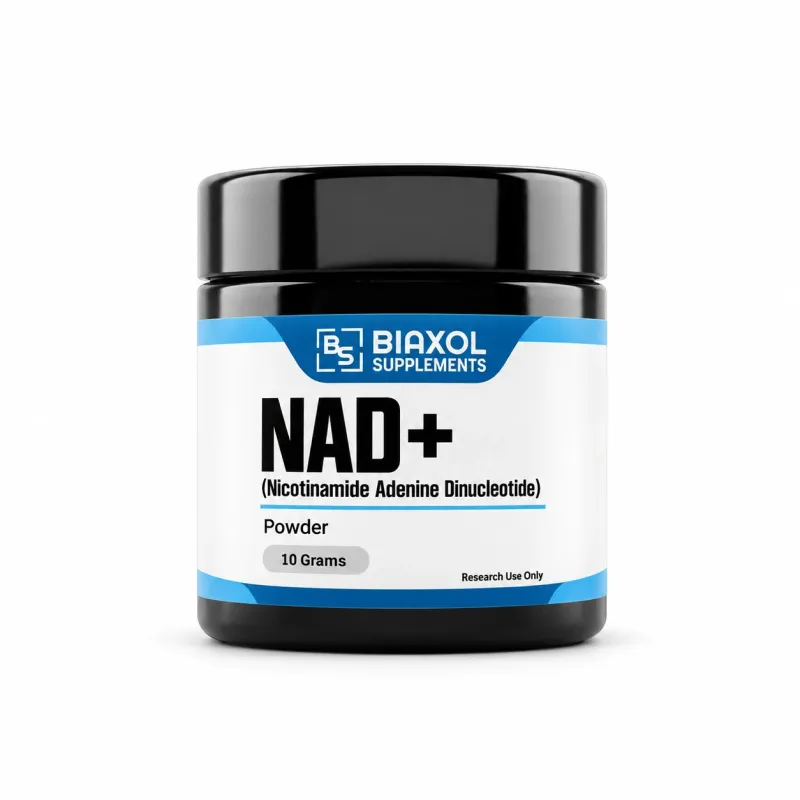
NAD+ (Nicotinamide Adenine Dinucleotide) – Powder, 10 grams
NAD+ powder (10 g) provides the oxidised form of the universal cellular redox cofactor in bulk unencapsulated format for laboratory applications requiring solution preparation, defined concentration assays, or high-volume research protocols.
-25% on everything – until October 31
25% off regular prices, replacing other product sales. Only the crypto payment discount can be combined.
Overview
NAD+ powder (10 g) provides the oxidised form of the universal cellular redox cofactor in bulk unencapsulated format for laboratory applications requiring solution preparation, defined concentration assays, or high-volume research protocols.
As with the injectable format, NAD+ serves as electron carrier in catabolic pathways and as obligate co-substrate for sirtuins (SIRT1–7), PARPs, and CD38/CD157. The powder format enables precise molar concentration preparation for in vitro biochemical assays.
- High Purity – 99% Purity Guaranteed
- Independently Lab Tested
- Research Grade Quality
- For Laboratory Research Use Only
Properties
| Chemical Formula | C21H27N7O14P2 |
|---|---|
| Synonyms | NAD+, β-NAD+, Coenzyme I, Diphosphopyridine nucleotide (oxidised form) |
| Molar Mass | 663.43 g/mol |
| CAS Number | 53-84-9 |
| PubChem CID | 5892 |
| Total Compound Content | 10 g powder |
| Shelf Life | 24 months |
Research
NAD+ (nicotinamide adenine dinucleotide) is a pyridine nucleotide cofactor utilized in oxidation-reduction chemistry and as a substrate for numerous NAD+-dependent enzymatic reactions. The powder format enables preparation of defined-concentration solutions for biochemical, analytical, enzymatic, and in vitro research applications. Experimental investigations utilize NAD+ in studies of sirtuin enzymology, PARP-associated pathways, CD38-mediated reactions, redox chemistry, electron-transfer mechanisms, cofactor-dependent catalysis, and NAD+/NADH equilibrium dynamics. Its high aqueous solubility and well-characterized biochemical properties make it a valuable research tool for enzyme kinetic analysis, cofactor-dependent reaction studies, redox biochemistry, and mechanistic investigations of NAD+-utilizing molecular systems. Supplied as powder (10 g). Independently third-party HPLC-tested; COA available per batch.FAQ
What is the aqueous stability of NAD+ in solution, and how should stock solutions be stored?
NAD+ undergoes gradual hydrolysis in aqueous solution, particularly under conditions that promote cleavage of the nucleotide structure. For experimental applications requiring maximum stability, solutions are typically prepared fresh or stored under conditions that minimize degradation.
Lyophilized NAD+ powder exhibits substantially greater stability than aqueous solutions and is generally maintained in sealed, moisture-protected conditions to preserve compound integrity. Researchers conducting enzymatic or analytical studies should account for potential degradation when preparing and storing NAD+ solutions.
How is the powder format used in NAD+-dependent enzyme assays?
The powder format enables preparation of defined NAD+ concentrations for biochemical and enzymatic investigations involving NAD+-dependent reaction systems. Experimental studies frequently utilize NAD+ as a substrate or cofactor in analyses of sirtuin enzymology, PARP-associated reactions, CD38-mediated pathways, redox chemistry, and cofactor-dependent catalytic mechanisms.
The ability to prepare assay-specific concentrations makes the powder format particularly useful for enzyme kinetics, concentration-response experiments, and mechanistic studies of NAD+-utilizing systems.
What is the advantage of the powder format for research applications?
The powder format provides flexibility for preparation of custom concentrations and incorporation into a wide range of biochemical, analytical, and in vitro experimental systems. It is particularly useful for studies requiring precise control of NAD+ concentration, assay-specific buffer conditions, enzyme kinetic analysis, redox chemistry investigations, and cofactor-dependent reaction studies.
These characteristics make the powder format a valuable option for research programs involving NAD+-dependent molecular and enzymatic processes.
Related products
-
 7,8-Dihydroxyflavone – Powder, 1 gramAdd to cartOriginal price was: €22,99.€17,24Current price is: €17,24.
-
 Oleoylethanolamide (OEA) 98%+ – Powder, 5 gramsAdd to cartOriginal price was: €34,99.€26,24Current price is: €26,24.
-
 Amentoflavone (20% extract) – Powder, 2.5 gramsAdd to cartOriginal price was: €32,99.€24,74Current price is: €24,74.
-
 Synephrine HCl – Powder, 20 gramsAdd to cartOriginal price was: €24,99.€18,74Current price is: €18,74.